Introduction
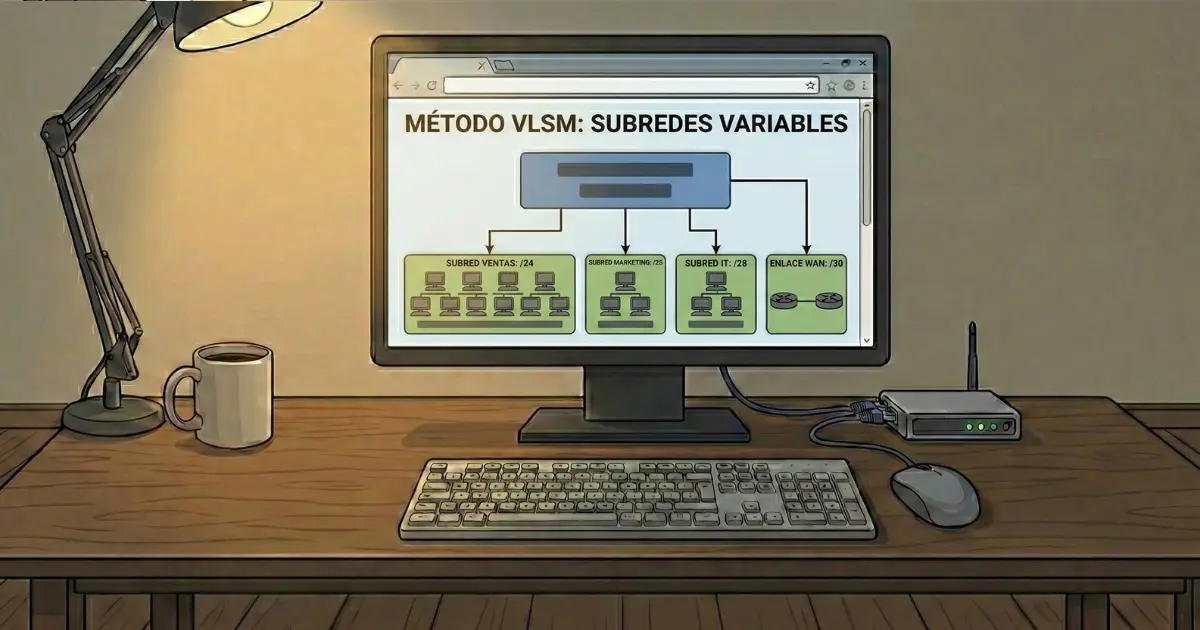
VLSM means Variable Length Subnet Mask. Instead of dividing a parent network into equal pieces, VLSM lets each subnet use a prefix sized to its actual requirement. That makes IPv4 allocation more efficient and better suited to real networks with different LAN, server, management, and point-to-point needs.
What VLSM is
VLSM creates child subnets with different prefix lengths inside the same parent allocation. One segment might receive a /25, another a /27, and another a /30. Every block still follows normal CIDR alignment rules; VLSM is flexible, not arbitrary.
When to use VLSM
Use VLSM when subnet requirements differ significantly or when conserving address space matters. It is common in enterprise and lab designs where user VLANs, server networks, management networks, transit links, and infrastructure segments need very different capacities.
VLSM vs FLSM
FLSM chooses one prefix for every child subnet. VLSM can choose a different prefix for each requirement. FLSM is simpler; VLSM is generally more efficient.
If five networks need 100, 50, 20, 10, and 2 endpoints, giving every network enough space for 100 endpoints wastes most of the parent block. VLSM lets each requirement receive a closer-fitting prefix.
VLSM in 30 seconds
- List all required networks and capacities.
- Convert each capacity to the smallest suitable prefix.
- Sort requirements from largest block to smallest.
- Allocate the first block at the beginning of the parent network.
- Move to the next free aligned boundary and allocate the next block.
- Repeat until all requirements are placed.
- Verify containment, alignment, and no overlap.
From host requirement to prefix
For a conventional IPv4 LAN, choose enough host bits so that 2^hostBits - 2 meets the requirement. Then calculate prefix = 32 - hostBits.
Examples: roughly 100 conventional hosts need a /25; 50 need a /26; 20 need a /27; 10 need a /28. Point-to-point /31 links and /32 host routes use different semantics and should be planned intentionally.
Prepare the requirements
Do not start assigning addresses in the order requirements were written. First normalize the requirements, identify special-purpose links, and sort by block size. Allocating the largest subnet first avoids fragmenting the free space into pieces that cannot satisfy later large requirements.
Also confirm the parent network is large enough. VLSM cannot create address space that does not exist.
Worked VLSM example
Suppose 192.168.10.0/24 must support networks for 100, 50, 20, and 10 conventional hosts.
- 100 hosts → /25 → allocate
192.168.10.0/25. - 50 hosts → /26 → next aligned block is
192.168.10.128/26. - 20 hosts → /27 → next aligned block is
192.168.10.192/27. - 10 hosts → /28 → next aligned block is
192.168.10.224/28.
The remaining space begins at .240 and can be used for additional smaller requirements if they fit.
Alignment and boundaries
Each subnet must begin on a valid boundary for its prefix. A /27 advances in blocks of 32 addresses, so valid starts in the relevant octet are 0, 32, 64, 96, 128, 160, 192, and 224. A /28 advances in blocks of 16.
If a block is large enough in raw address count but starts at the wrong boundary, it is not a valid subnet of that prefix.
Avoiding overlaps
Two allocated subnets must never share addresses. Track the first and last address of each block and always continue from the next free boundary. SubnetMaster includes an overlap checker that is useful for validating plans imported from spreadsheets or documentation.
Keep future summarization in mind
Good VLSM planning is not only about saving addresses. Group related networks in contiguous ranges when possible so routing can later summarize them. Hierarchical allocation makes route tables and troubleshooting easier to understand.
Common VLSM mistakes
- Allocating small blocks before large blocks.
- Choosing a prefix that satisfies total addresses but not the intended host semantics.
- Starting a subnet at a non-aligned address.
- Forgetting the parent network boundary.
- Leaving undocumented gaps that later create confusion.
- Assuming two prefixes do not overlap without checking their complete ranges.
VLSM checklist
- Parent prefix verified.
- Requirements normalized and sorted largest first.
- Smallest suitable prefix selected for every requirement.
- Every start address aligned.
- No overlaps.
- Every child contained inside the parent.
- Gateways, VLANs, purpose, and reservations documented.
Next step
Use the VLSM calculator to validate a manual plan, then continue into switching and routing where these subnets become VLAN interfaces, transit networks, static routes, and dynamic routing prefixes.