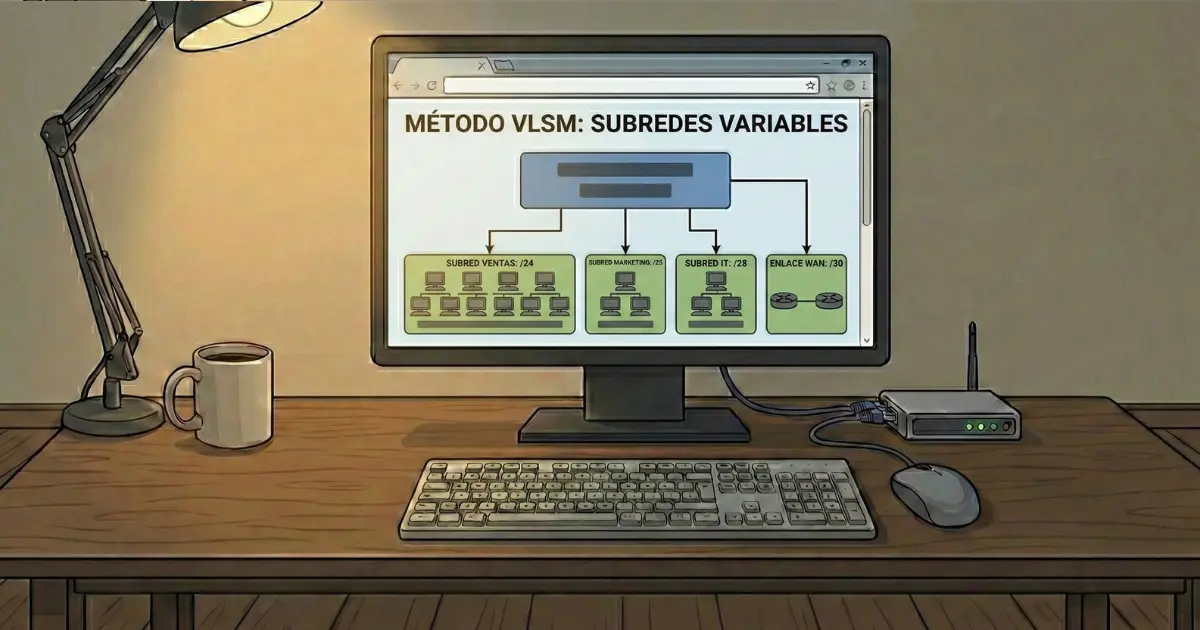
The key idea: VLSM is about planning before dividing
Unlike FLSM, VLSM does not make every subnet the same size. Each block can be different, and if you do not follow an order, mistakes become very easy to make.
What the VLSM method is
VLSM means Variable Length Subnet Mask. It lets you create subnets with different masks inside the same base network, sizing each subnet for its actual requirement.
Different-size subnets
Each subnet uses the prefix it actually needs.
Multiple prefixes
/26, /27, /28… can all coexist inside the same network.
Planning first
Before dividing the network, you have to sort and decide.
Real-world subnetting
This is the method commonly used in real networks.
When VLSM makes sense
Different departments
Each network needs a different number of hosts.
Address efficiency
You do not want to waste IP addresses.
Real networks
Business and professional networking scenarios.
Intermediate level
You already understand FLSM and are ready for the next step.
Before you start: the essential VLSM checklist
List the requirements
Know how many hosts each subnet needs.
Descending order
Always work from the largest requirement to the smallest.
Know your prefixes
Know which prefix can cover each requirement.
Think in blocks
Keep thinking in address blocks, not isolated IP addresses.
The VLSM method by hand in 6 steps
Visual example: VLSM blocks
| Subnet | Prefix | Network | Hosts | Broadcast |
|---|---|---|---|---|
| Network A | /26 | 192.168.1.0 | 62 | 192.168.1.63 |
| Network B | /27 | 192.168.1.64 | 30 | 192.168.1.95 |
Common VLSM mistakes
Not sorting by size
The number-one mistake.
Overlapping blocks
Assigning a network that overlaps an earlier allocation.
Going too fast
VLSM rewards a calm, ordered process.
Not verifying
The calculator is your safety net.
Resources for learning VLSM
Complete VLSM guide
Subnetting guide
VLSM calculator
Wrapping up
VLSM is real-world subnetting: planning, different block sizes, and a disciplined order. Once you master this method, you can handle almost any subnetting exercise you are given.