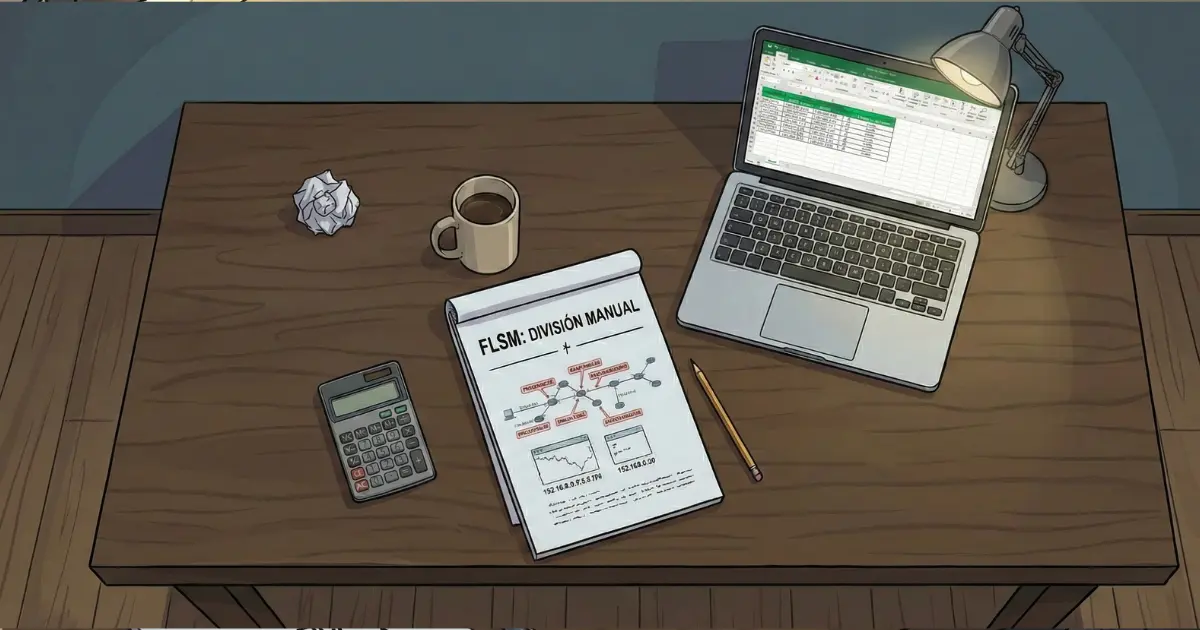
The key idea: FLSM teaches you the pattern
If you are just getting started with subnetting, FLSM is the best entry point because it forces you to understand the essential idea: the network is divided into equal-size blocks. No subnets of different sizes, no “magic.” Just a repeatable pattern.
What the FLSM method is
FLSM means Fixed Length Subnet Mask. In practice, every subnet uses the same mask, so they all have the same size and the same number of available hosts.
Equal-size subnets
You divide a larger network into blocks of the same size, using the same increment.
One prefix length
The prefix (/26, /27, and so on) applies to every subnet.
A repeatable pattern
Once you calculate two subnets correctly, the rest follow the same pattern.
Real understanding
It is one of the best methods for learning because it trains you to think in blocks.
When FLSM makes sense
FLSM is not “better” than VLSM; it is simpler. You would use it when:
Similar departments
Several subnets need roughly the same size, for example classrooms or floors in a building.
Simple management
You want a structure that is easy to document, understand, and maintain.
Learning subnetting
You are training your eye and your reasoning before moving on to VLSM.
No unusual sizes
You do not need to optimize every address as tightly as possible; that is where VLSM helps.
Before you start: minimum checklist
Before doing exercises, make sure these ideas are clear. If one piece is missing, you will get stuck:
Network / Broadcast
The first and last IP addresses in the block. Host addresses are always between them.
CIDR prefix
/24, /26… how many bits belong to the network and how many belong to hosts.
Block size
“How often a new subnet starts.” This is THE pattern you need to see.
Powers of two
Hosts, subnets, increments… almost everything falls into powers of two.
The FLSM method by hand in 6 steps
Here is the process to repeat every time. The key is not skipping steps. If you choose the wrong prefix or block size, everything after that will be wrong too.
.0, .block, .2*block…. Without it, you are working blind.Visual example: a small subnet table
Even without doing a full exercise here, this is the table format you should repeat every time. It helps you see the pattern and keeps the concepts separate.
| Subnet | Network | Host range | Broadcast |
|---|---|---|---|
| #1 | 192.168.1.0 | 192.168.1.1 – 192.168.1.62 | 192.168.1.63 |
| #2 | 192.168.1.64 | 192.168.1.65 – 192.168.1.126 | 192.168.1.127 |
How to practice FLSM until it sticks
The most effective practice is not doing one perfect exercise. It is repeating the process until you can work through it calmly without freezing up.
Paper / a simple table
Write down networks and broadcasts. The goal is to see blocks, not memorize answers.
Progressive levels
Start with /24 → /26. Then move to /27, /28… and later work across octet boundaries.
Self-correction
Finish it by hand and then verify with a tool. That way the mistake teaches you something.
Short repetition
10–15 minutes a day. Consistency works better than two-hour marathons.
Common mistakes when learning FLSM
These are the mistakes that cause the most frustration. If one happens to you, it simply means that part of the process is not automatic yet.
Choosing the wrong prefix
If the prefix cannot satisfy the host/subnet requirement, nothing else can line up correctly.
Getting the block size wrong
The increment is not something you guess. It is the size of the block. No block size means no pattern.
Mixing up network and first host
The network address starts the block. The first host is network + 1.
Filling the table without checking
If subnet two is already wrong, everything after it will be wrong too, and you will waste time.
Useful learning resources
Complete FLSM guide
Subnetting guide
FLSM calculator
CIDR → Hosts
Wrapping up
FLSM is the cleanest way to train your brain for subnetting: equal blocks, a clear pattern, and repeatable practice. If you master this, moving on to VLSM will feel much less demanding.